{{ item.dateLabel }}
{{ item.description }}
Assistant Professor in the School of Computing and Faculty Fellow at the Institute for AI at the University of Georgia.
I care deeply about solving fundamental questions in computer vision and general AI, and about building on these results to create models and tools that push the boundary of science and improve people's quality of life.
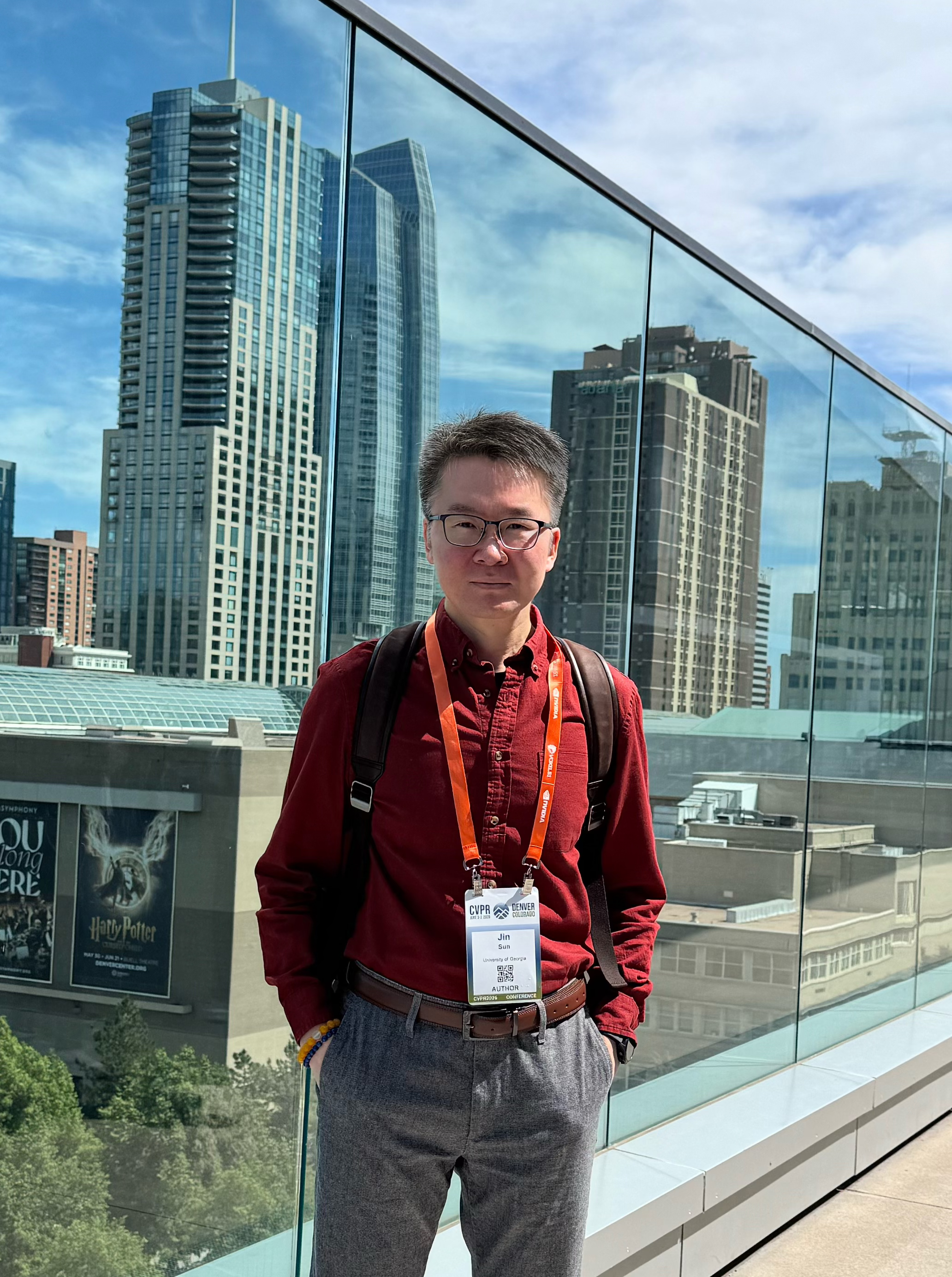
Understanding our world using visual data with state-of-the-art deep learning — and applying it to create meaningful impact across science and society.
Core problems that shape how intelligent systems see, interpret, and generate the visual world, and how to build models that do these things well.
How deep neural networks behave, learn, generalize, and build useful multimodal representations.
How to create meaningful impact through AI beyond traditional computer vision and machine learning applications.
A selection of recent and representative publications. For a full, up-to-date list, please see my Google Scholar profile.
No publications match the current filters.
Courses in computer vision, deep learning, data science, and representation learning at the undergraduate and graduate levels.
Deep dive into representation learning and its applications; research project component.
Course information →I'm currently an Assistant Professor in the School of Computing and a Faculty Fellow at the Institute for Artificial Intelligence at the University of Georgia. I'm also a Lilly Teaching Fellow.
I have spent wonderful years at the following places. Previously, I was a Postdoctoral Associate at Cornell Tech, working with Prof. Noah Snavely. I received my PhD in Computer Science from the University of Maryland, advised by Prof. David Jacobs. I was in a 3+2 program, receiving a Master's degree in Computer and Information Science from Temple University, advised by Prof. Haibin Ling, and a Bachelor's degree in Automation from the University of Science and Technology of China (USTC).
Dr. Jin Sun is an Assistant Professor in the School of Computing and a Faculty Fellow at the Institute for Artificial Intelligence at the University of Georgia. He is also a Lilly Teaching Fellow. His main research area is computer vision—understanding the world using visual data with the help of state-of-the-art deep learning models. In particular, he is passionate about understanding objects in diverse and complex environments using images and videos. He is actively collaborating with researchers to apply AI in interdisciplinary research to push the boundaries of scientific discovery and improve people's quality of life. His work has been published in top computer vision and machine learning conferences such as CVPR, ECCV, ICCV, NeurIPS, ICML, and ICLR. His research work has been selected as Notable Books and Articles in ACM Computing Reviews in 2014 and Best Paper Nominee in CVPR 2020.